All things bright and beautiful

Yesterday the kids and I went with some of our homeschool friends to the Natural History Museum in Tring. It was incredible! If ever you need a reminder of the awesomeness of creation, this is a great place to go. By the end of the day I had a renewed appreciation of the beauty and wonder God has put into the world, and of His majesty and power.
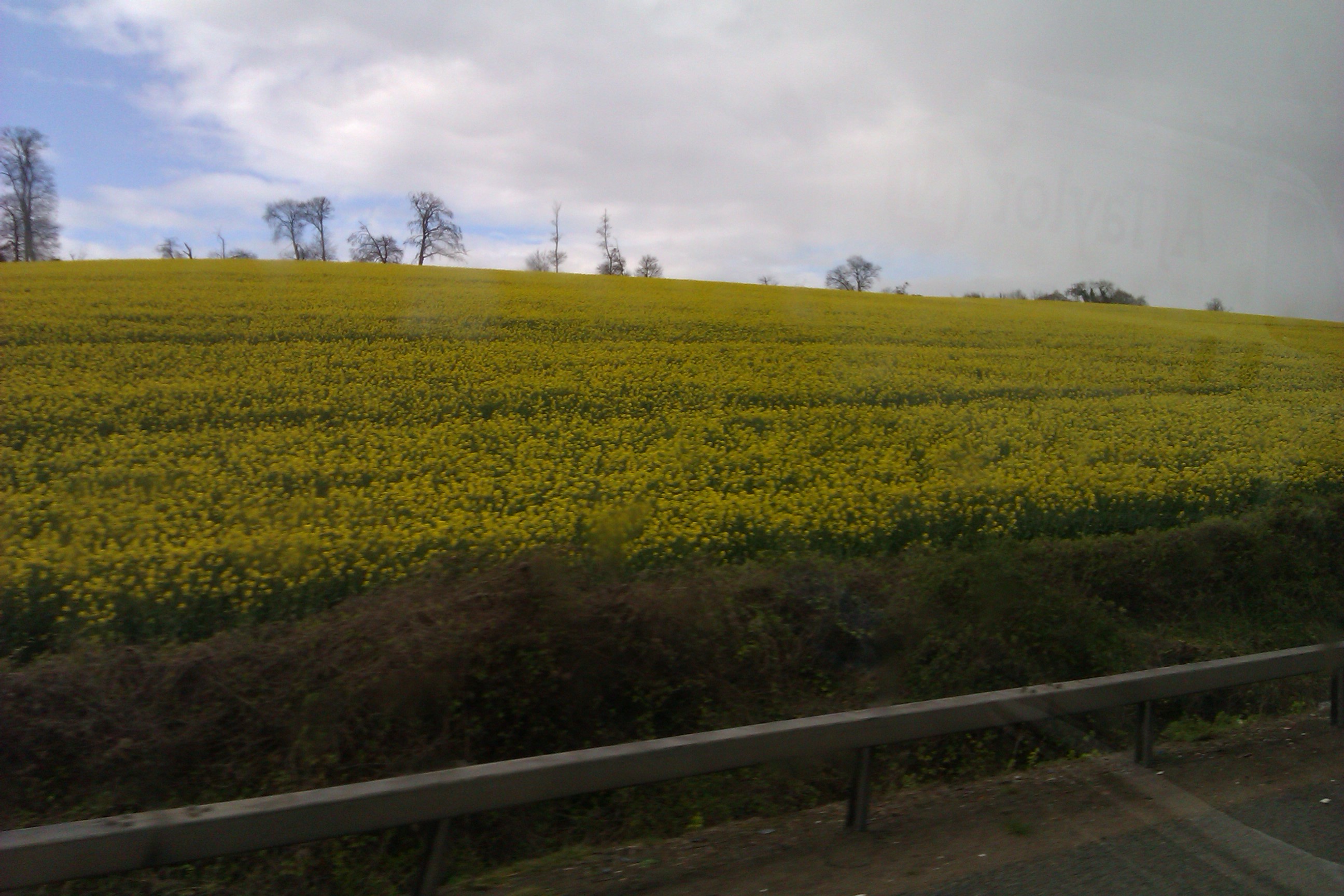
The green field - I caught it on camera on the way back home.

Tring is about just over an hour away from us, but due to rain and road works the journey took us two hours to get there. It was a pretty grey day, and I was looking out the wet windows as we drove along the motorway, not seeing anything of particular interest. Suddenly, as we rounded a curve in the road, a gorgeous bright yellow-green field came into view. It took my breath away! I was awed by the simple beauty of the crop, as it stood out bold and cheerful though dull, damp air. Wow – God can sure paint a scene!

The view across the hills as we left the motorway.

As we drew nearer to Tring the weather cleared up a bit. The blue sky brightened the day as we turned off the main motorway and began to drive along the winding roads. The countryside here was soft and green, with rolling hills, grazing sheep, and dandelions providing spots of yellow colour. I wished I had time to stop and walk though it all, and really take it in. As it was I had to simply enjoy it as we whizzed past, and attempt some pictures with my HTC phone camera!

God is amazing!

By the time we arrived I already knew that I would have to share this wondrous beauty with you all today. Little did I know what was waiting inside to confirm that decision! The car park was tiny and subjected to construction work, and the building looked like it could hardly hold anything of value. I gathered a few of the kids while our driver kindly went to look for a parking space further afield, and we walked into the building. We were greeted by friendly people, who showed us where to buy some activity sheets for the children. After spending £1.50, gathering pencils and drawing boards, and checking I had the right number of kids with me, we entered the first gallery.  Wow.

I could have stayed in this gallery for hours. I think we did spend about 45 minutes there. It was a small room for a museum – hardly bigger than the square footage of my flat – but it was packed from floor to ceiling with animals. There were bears, wolves, gorillas, big cats and birds of all kinds. Up above we could also see glimpses of safari and ocean creatures, which we saw in more detail when we got upstairs to gallery three.

It’s hard to say what my favourite part of the museum was, but I can narrow it down to three top experiences:

  1. Seeing the incredible beauty of a huge variety of birds up close.  I  have never been particularly interested in birds, but I’ve been getting more taken with them as I get older. Yesterday upped my interest a lot!  There so many varieties, and all so beautifully and intricately designed.
  2. The delighted cries and amazed faces of the children.  From the moment we entered until we left the children were moving from display to display, calling out for us to look at each new amazing discovery. They loved being so close up to the animals, seeing what they really look like. They took time to learn new facts, compare and contrast species and draw their favourite creatures.
  3. The ocean gallery.  Prince is very into ocean creatures at the moment, and whenever he is passionate about a topic I find myself being drawn into it too. The coral, crabs and sharks were particular favourites of mine in this section.  There was such detail, beauty and power in these creatures.

We stopped for a yummy indoor picnic half way through our exploring, and then made our way around the last galleries in the museum. After browsing the gift shop (Prince bought a pen for drawing with his own money), and a last trip to the loo, we walked back to the car. It was parked down a little village street, opposite fields where a few handsome horses were grazing.  Just lovely.

In our bedtime prayers we all thanked God for the amazing day out, and for the creation which we were blessed with witnessing that day.

For since the creation of the world God’s invisible qualities—his eternal power and divine nature—have been clearly seen, being understood from what has been made, so that people are without excuse. Romans 1:20 (NIV)

Why we homeschool

Our family has made the choice to home education our children, rather than put them in the school system. Below is an outline of the ‘why’ behind our decision. This is certainly not an exhaustive list of our reasons for choosing to homeschool our kids. It is also not intended in any way to make others feel guilty for sending their kids to school. It’s simply an overview of some of the most important and outstanding reasons we believe that – for us – homeschooling is the option we must (and desire to) choose.

Spiritual Training.  Just as a solider training for war should go where he can be BEST trained, so we – training our kids for the spiritual war they will engage in as they grow – want to train them in the BEST possible place. In our opinion, this is not a school setting.  Why?  Because:

  1. We want to create an atmosphere where prayer, Bible study and unconditional love are a central part of their learning process, as we believe this creates a solid foundation for a life of love. (Deut 6:6-8)
  2. We want to be able to frequently and consistently show them how the Biblical principals of love, kindness and responsibility should influence thoughts and behaviour, and train them to make this a personal habit for life.  (Proverbs 22:6)
  3. We want them to be totally immersed in an atmosphere of love, acceptance, affirmation of who they are, and be the ones to provide consistent and loving discipline. At school we perceive that they will be too exposed to anger, bullying, discouragement and lack of discipline which can negatively impact character development.
  4. We want them to regularly observe adults and children who model love, integrity and diligence – characteristics we feel they should be aspiring too. Kids imitate what (and who) they see the most.
  5. We want them to be comparatively free from the long and daily peer pressure to conform to worldy standards. We want to control such exposure so they learn to love those they disagree with, rather than imitate them.

Academic excellence.  With ratio at almost always close to 1:1, we believe that education at home is far more likely to be of good quality than education at school. Even without formal teacher training we believe this is achievable. How?  Because:

  1. We can work hard at developing and maintaining a love for learning in our children. This (which is so easily and quickly lost in school settings) will help them to be life-long learners, and people who are diligent to search out whatever they need to know in the future.
  2. We are able to be very in tune with what subjects and topics each child enjoys, finds easy, or struggles with in some way. We can tailor their education to these strengths and weaknesses, moving ahead quickly when they excel, and taking the time needed when they would otherwise have struggled.
  3. We can focus on true understanding rather than test scores. Learning can be put into context and become meaningful, rather than abstract.  Long term learning is the goal.
  4. With the responsibility on our shoulders of educating our children, we tend to learn alongside them. This means that we are able to weave threads of learning easily through-out life as whole.  Learning becomes a natural part of life, not a 9am-3pm chore.  It also becomes a shared process of enjoyment and mutual encouragement.

Personal development.  There is no need to fear a lack of socialisation in homeschooled children – in fact the opposite may be true. Homeschooled kids are constantly around a variety of ages, and learn how to interact in everyday life, rather than the artificial situation which a class, year or grade makes up at school. With homeschool co-ops, clubs, music, art, swimming, church, camps, etc, there are no shortages of opportunities to socialise. But apart from this, there are other personal developmental benefits to homeschoolng:

  1. Self-discipline.  Opportunities to learn by one’s own initiative come up frequently in home education, and this promotes self-discipline, a huge benefit for life in the adult world.
  2. Problem solving.  While this can certainly be learnt at school, it may not be taught as specifically as we would like. We want to be around to teach loving and peaceful ways to solve both interpersonal and situational problems.
  3. Acceptance of others. Unlike the cliques which develop so easily in school settings, we can encourage children to play with, help and engage with people of all ages and abilities.
  4. Personal conviction.  Children should be free to question and challenge ideas and beliefs in an atmosphere of open-mindedness and honesty. We will not teach them just one view as right, to be taken as fact without question, but rather encourage them to examine and search out the evidence for themselves.  We will explain what we believe and why, and actively help our children to make their own decisions based on accurate interpretation of the available evidence.

Ultimately, we feel that God has given us (not teachers, day-care providers, babysitters or anyone else) the responsibility to bring our children up “in the training and admonition of the Lord” (Eph 6:4), and feel that we will best carry out that responsibility by educating our kids at home.  We believe that education at home can be first-class, and that the personal skills instilled will best prepare them to go into the world as loving, useful members of society.

The beauty of homemaking

I always knew that becoming a mother was a career choice for me. To my mind, it can’t be anything else. Raising children is not something to be done on the side, in our spare time, but something which calls for the highest standards of commitment, sacrifice, dedication and effort. I’d like to share some of the common reasons I hear against mothers choosing to stay home with their children, and my responses to these reasons.

1) Some people seem to think that women who choose to stay at home full time are unambitious. Firstly, ambition is not what life is about. Secondly, I think being a stay-at-home Mom is probably the most ambitious career out there! A housewife and mother has to master so many different facets of life. She is a cook, a cleaner, an arbitrator, a psychologist, a day-care provider, a mentor, a friend, a nurse, a teacher, a personal shopper, a playmate, and a care assistant. On top of these she may well specialise in a few other areas, such as baking, craft making, research, nutrition, health, sports, music, or just about any other subject or vocation you can think of. Being a full time homemaker is anything but boring!

There are joys in motherhood that can never be found in another career.

2) The other objection I frequently hear against being a stay-at-home Mom is that of financial strain. I admit that sometimes this is an issue. However, I think it is much less of an issue than most people perceive it to be. If you are thinking, “We can’t manage without two incomes.” I would encourage you to think again. Our lives are usually full of unnecessary stuff, which could be cut out to reduce our monthly expenditure. And if you really do need more money, then there are ways to work around this and still stay at home. Right now, for example, I am bringing in some extra money for my family by joining Usborne and selling children’s books. This allows me flexibility to work around my kids, rather than mothering around my work. It’s important to really evaluate our priorities, and make sure we are backing what we believe by the way we live. It’s no good wishing we had the resources to stay at home, but in reality placing a higher value on home decoration.

3) The last reason I commonly hear for women not staying at home is, “It’s just not for me.” This may be true. But what about your kids? To simply say “it’s not for me” seems a rather selfish reason. If you have carefully weighed all the pros and cons, if you have decided that you need to prioritize something else, or if you have prayed and prayed and prayed and still believe it is ‘not for you’, then I respect that. God has certainly called each of us to our own ministries, and we must act accordingly. But if you simply have a fear that you won’t like being a homemaker, then I truly hope you will stop and think again. There are such joys, such excitements, such challenges, blessings, and wonderful experiences to be had when you make your kids your career.

In closing, take time to read one of my favourite passages of Scripture, encouraging young mothers to keep her priorities right in the sight of God.

“Older women likewise are to be reverent in their behavior, not malicious gossips nor enslaved to much wine, teaching what is good, so that they may encourage the young women to love their husbands, to love their children, to be sensible, pure, workers at home, kind, being subject to their own husbands, so that the word of God will not be dishonored.”  Titus 2:3-5 (NASB)

Speaking of love

I have recently been reading through Gary Chapman’s ‘The Five Love Languages of Children‘. I had read his earlier book on love languages, so was looking forward to this one. Although I’m not finished reading it yet, I wanted to share some things I have learned and some thoughts it has sparked.

The overriding principle behind the book is that every person – children included – feel love in one of five primary ways (referred to as ‘languages’): physical touch, words of affirmation, quality time, gifts and acts of service. Dr Chapman states that:

“Your children can receive love in all of the languages. Still, most children have a primary love language, one that speaks to them more loudly than the others. When you want to effectively meet your children’s need for love, it is crucial to discover their primary love language.”

A kiss from Princess 🙂

I think this is a true concept. When I stop to think about it, I can see in my kids some very definite ways in which they express and cry out for love. My Princess thrives on touch and words – she loves to give and receive kisses, hugs and strokes, and is always saying, “Mommy – I love you!” out of the blue. My Prince desires quality time more than anything. There’s nothing he loves more than having me or Daddy join in with his games.

If you have children, take a moment to think about what their primary love language might be. It is not always obvious, especially if they are quite young. One of the clues to look out for is ways that they express love. Another thing you can do is ask them, “Do you know I love you? Why?” It may be that you don’t come up with one specific language – that’s fine! But you also might find that when you really think about it, there is one type of expression which resonates with your child more than others. If this is the case, I recommend taking the time to make sure you are showing your child love in this specific way every day.

One of the things about figuring out your child’s love language is that once you identify it, you need to start acting on that information! Some are easier to give than others. For me, it’s much easier to give a hug and say I love you, than to stop what I am doing to play Octonauts – but it is just as important. For others, playing imaginary games may be easy as pie, but if your child needs words of affirmation then this is what you must give primarily. Hard as it may be, it’s worth the effort.

Hilarity trying to get a ‘nice’ smile at our Mother’s day lunch!

About a month ago I noticed that we were having to tell Prince off more than usual. Knowing his need for quality time I decided that it would be a good idea for my husband or I to take him out somewhere alone, to build him up and encourage him. The timing coincided with Mother’s day, so Prince and I went out for a cheap McD’s lunch together. I spent the time really focussing on him – listening to the things he wanted to talk about, and laughing at his jokes. I also took the opportunity to ask him some questions about my parenting, how he felt about things, and asked for his perspective on how I could improve as a Mommy. Although we were only alone for about 45 mins, that less-than-an-hour-cheap-and-greasy lunch made the world of difference to his behaviour. He seemed to have got exactly what he needed. In Dr Chapman’s words, his ‘love-tank’ was filled.

The love language concept is not a guaranteed fix all solution for behaviour problems. However, it is well documented that a lot of negative behaviours occurs as a cry out for love, and so it follows that this can be solved by ensuring your child feels truly loved.

Another theme that has stood out to me in this book is that we need to be willing to sacrifice in order to show our children love in a way they can understand loud and clear. We need to be able to step out of our own comfort zone; we need to make time for our kids in our busy schedules; we need to put effort and thought into the way we express our love. I really like what Gary Chapman says here:

Don’t be a victim of the urgent. In the long run, much of what seems so pressing right now won’t even matter. What you do with your children will matter forever.

It’s not about showing love in ways which are convenient, quick, easy, or come naturally to us. It’s about caring enough to reach out to our kids, and make the effort to say ‘I love you’ in their own language.

There are many important things to do in life, but few are more important than raising our children to know that they are loved unconditionally – both by us and, ultimately, by God.

Natural learning

As a homeschooling Mom, one of my greatest joys is watching my children learn new things. Right now we don’t follow any particular curriculum, have any set ‘school work’ for each day, or follow any term timetables. Instead, we are adopting a relaxed, holistic, natural learning method. Whilst there are merits with a classroom style approach to education, I believe that the best learning happens in every day life, as we pursue our interests and talents, as we master necessary skills, and as we encounter people with a passion for different topics. I think this is especially true for young children, who find it so hard to sit still and listen to lessons. As the kids get older I will re-evaluate our style, but for now natural learning is working for us.

So what does this natural learning method involve, and is it effective? The short answers are ‘a willing heart’ and ‘yes’. For the longer answers, read on 🙂

It’s hard to say what a ‘typical’ day looks like at our house, in terms of education, but here are some things that happen fairly often:

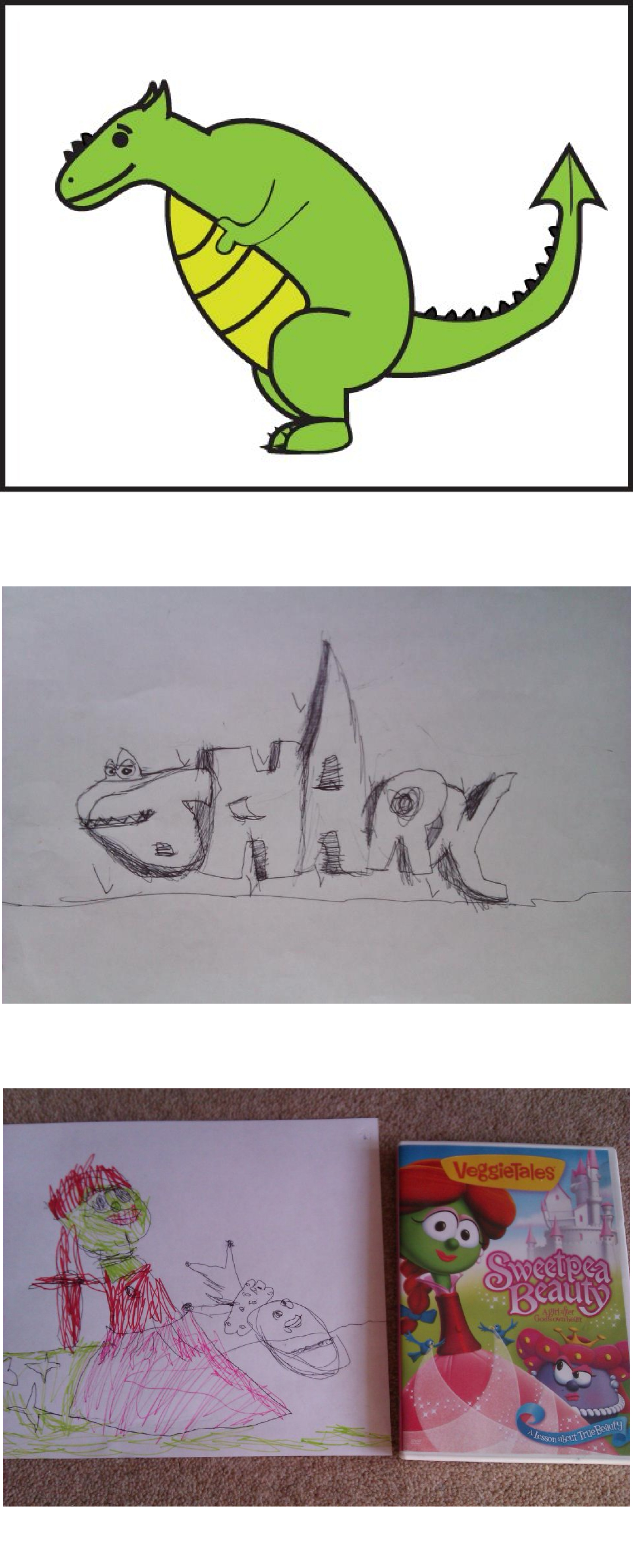
  • Top: a graphic design project Prince and I created
    Middle: ‘Shark’ from ‘WordWorld’, by Prince age 5
    Bottom: Copywork by Princess, age 3

    Reading.  All kinds of books are read in our house. So far today, for example, the kids have read (or listened to me read) ‘The Life of Jesus’, ‘Usborne First Illustrated Maths Dictionary‘, ‘The Story of the Olympics‘, various sections from ‘Animal Kingdom’, ‘The Big Dark’, ‘My Daddy is a Giant’ and ‘Lines and Squares’. Out of all these the only one I initiated was the poem, ‘Lines and Squares’. This reading has provided learning in the following ‘school’ topics: English (reading), religious education, maths, English literature, history and geography.

  • Drawing.  My kids are prolific drawers! They have usually drawn a few pictures each before I am even out of bed.  They take great care and devote a lot of time to their pictures. This, obviously, covers the topic of ‘art’, but we also find that their drawings inspires learning about other topics, such as geography. Today Prince also helped me create the graphics for his birthday invitation in Adobe Illustrator, which provided some ICT learning.
  • Dancing and music.  Princess especially likes to dance. She is inspired by her cousin, and also loves to choreograph her own dances and put on shows. We have a variety of classical music we love to listen to, and our favourites are Vivaldi, Mozart and Andrea Bocelli. With this we cover some P.E., music, and performing arts.
  • Questions and conversations.  Prince is at that inquisitive age, where it’s practically impossible to keep him from learning! He’s always asking questions about things, and having conversations with Daddy or me about topics which interest him. Sometimes we expand upon this by looking up more information in a reference book (our dictionary or atlas), or searching on the internet. A lot of educational topics are covered this way.
  • Writing.  Both kids like to make their own books, written and illustrated. Prince is developing quite a collection. They also write messages on their pictures, write out the ‘verse of the day’, and today Prince wrote out names on his birthday party invitations. We use these opportunities to learn spelling, grammar, handwriting, composition, creative writing, etc.

There are so many other opportunities that come up ever day – it’s impossible to even remember them all, let alone list them! We do field trips, cooking, painting, gardening, counting, telling the time, astronomy, patterns, imaginary play, construction, French, life skills, science, environmental awareness, health and nutrition, and much more.

In summary, natural learning is a fun, holistic approach to eduction. The key to making it work is, in my opinion, an open, willing mind and dedication. When we take time to see and take hold of the learning opportunities in every activity we can inspire our children to learn and seek out knowledge through their everyday life.

Guest Post: Hannah’s Heart

I’d like to thank my dear friend Monique Demas for writing today’s guest post.

Playing mommies as little girls, now blessed mommies as grown-ups!

Have you ever desired something so much that you lost your appetite and sleep over it? Have you ever fervently prayed for something and waited for God’s answer?

During a difficult period in my life, I remember sleepless nights with painful tears and constant prayers. My husband and I desired to have a baby.  We had been married seven years, and the doctors told us that we might not be able to have a child. However, the constant reminder that the God of the universe is in control gave us strength.

When I read Hannah’s story in 1 Samuel 1, my heart understands her anguish.

Sometimes we do not understand God’s timing. Every year, Elkanah, Hannah’s husband went to worship at Shiloh, and his other wife Peninnah provoked Hannah about being barren (1 Samuel 1:5-7 ESV). Verse 7 mentions how Hannah wept and would not eat. The Scriptures say in verse 10, “She was deeply distressed and prayed to the Lord and wept bitterly.”
Hannah’s heart was in the right during this painful time. Verse 13 says she was speaking in her heart while praying. While praying, she made a vow to God, “O Lord of Hosts, if you will indeed look on the affliction of your servant and remember me and not forget your servant, but will give your servant a son, then I will give him to the Lord all the days of his life, and no razor will touch his head.” (verse 11)

The Lord blessed Hannah with a son, and she gave him back to God. In verse 22, the Scriptures say, “As soon as the child is weaned, I will bring him, so that he may appear in the presence of the Lord and dwell there forever.” Wow! How powerful! Hannah’s son Samuel was to appear in the presence of the Lord and dwell there forever.

On December 2, 2010, we found out we were having a baby. Our hearts were full of joy when God blessed us with a baby boy! It was very convicting to read of Hannah’s heart whose deepest desire was for her child to dwell in the presence of the Lord forever. We see from the Scriptures that Hannah’s desire to have a son was a godly desire. We are able to see the difference between a godly desire and fleshly desire in this story. A fleshly desire is a yearning for something that upon receiving, one refuses to give back to God.

As mothers, we must have Hannah hearts. Our children are a heritage from the Lord (Psalm 127:3), and we must train them in the way of the Lord (Proverbs 22:6).

Let us constantly remember that our job as mothers is to train our children to have an understanding of their Creator and to dedicate their lives to Him. Live each day with Hannah hearts!

Seasoned with salt – lessons from my Mom’s roast dinners

“Be wise in the way you act toward outsiders; make the most of every opportunity. Let your conversation be always full of grace, seasoned with salt, so that you may know how to answer everyone.”
Colossians 4:5-7 (NIV)

I love the imagery used in the passage. Full of grace; Seasoned with salt. It makes me think of my Mom’s home-cooked Sunday roasts. We would come home after church (usually with an eager guest or two) and the scent of potatoes, veggies, meat, Yorkshire puddings and gravy would fill the air as she finished off the final touches of the meal. It was a delicious, comforting, wholesome smell, and the food was always just as good as the anticipation. I think my Mom really IS the best cook in the whole world. But I’m getting side-tracked…

In these three verses of Colossians, the author Paul is referring specifically to the way we talk with people who are not part of the body of Christ. But I would like to take his idea and apply it to the way we talk to our kids. In a way, it’s not too different, because both are in need of experiencing the grace and love of Jesus through the way we talk to them.

Opportunities abound in the life of a parent.

Paul urges Christians here to “make the most of every opportunity”. As parents, we have LOTS of opportunities to witness to our children. We are around our kids a large part of every day, and talk to them often about a myriad of different topics. Because it happens so often, it is easy to forget that these conversations are chances for us to show the wonderful love and grace of Jesus. Unfortunately, it is especially easy to forget this in times of discipline, where it can be most important and have the greatest impact.

We need to be aware (and yes, intentional!) of the way we talk to our kids, and not let these opportunities slip by every day. We also need to be careful that we are not seasoning our conversations with judgement and bitterness instead of grace and salt, as so often happens.

But what is a conversation full of grace and seasoned with salt like? Well, I think it’s a bit like my Mom’s roast dinners…

  • It is wholesome.  It is not rude, inappropriate or unkind. Rather, it is respectful (it is possible to be respectful whilst still being in charge), carefully worded and loving. For example, instead of saying, “I told you to pick that up – do it now!”, we can say “Do you remember that I already asked you to pick that up? You need to remember to listen and obey straight away. Please do it now.”
  • It smells good.  Even though our words don’t have actual smells, they do have a scent in their own kind of way.  Conversations which are full of grace and seasoned with salt will have an overall good smell to them. Our kids will be able to tell that what we are saying is right and true and good, whether we are praising them or disciplining them.
  • It provides nourishment.  Although for the most part I loved my Mom’s roasts, there were occasionally vegetables I wasn’t so keen on. Even these, though, I would usually eat as I knew they were healthy and good for my body. In the same way there might be times we have to say things to our kids that they won’t want to hear.  We need to make sure that at these times we are full of grace and salt, and that we are speaking only to benefit out children, not to vent our anger.
  • It is comforting.  On the other hand, there are also times when our words can be a great source of comfort to our children. Here we can take the opportunity to show our kids the love and peace and joy that can be found in Jesus, no matter what circumstances we are living through.

Mom and me.

I want to end with a thanks to my Mom.

Thanks for your wonderful Sunday roasts, and for the lessons of love you have taught me all my life.  I love you.

Remember the Easter story

What is the first thing you think of when you hear the word ‘Easter’? Hopefully you said something like ‘Jesus’ or ‘sacrifice’ or other words related to the reason behind the season. Hopefully you didn’t say ‘chocolate’. But the truth is, most of us have a very strong association between Easter and chocolate. Whilst I’m not against buying Easter goodies (I confess to being rather a chocoholic…), I do think it’s very sad that eggs, chicks and bunnies have taken precedence over Jesus at this time of year.

Taking the first question a step deeper, ask yourself (or even better, your kids) – What is the first thing your children think of when they hear the word ‘Easter’? If they are only little, you may be inclined to be more understanding if they answered ‘chocolate’, but I think this is just more sad. They have had less time exposed to the commercialism of the world, and are more influenced by us. What are we teaching our kids? Are we actively and intentionally teaching them about Jesus’ gift to the world, or are we letting them grow up to think of Easter simply as a time to buy chocolate?

The commercialised world we live in puts an unthinkable amount of money and resources into strengthening our association between Easter and buying chocolate – and baskets, and stickers, and cards, and fluffy chicks, and stuffed bunnies and anything else it can think of. But nice as these things can be, they have nothing on the awesome events that we are actually celebrating this Easter. How can chocolate compare to salvation?! As parents, we should be passionate about teaching our children the real, eternal significance of the events that took place on the first Easter.

But how can we do this? Teaching our kids to think of Jesus before chocolate isn’t always easy! I think the answer is twofold:

  • Firstly, we need to emphasis the Easter story to our kids. Tell it to them over and over. Write it down, make crafts about it, draw pictures of it, sing songs about it, watch movies on it, play games about it. Get it into their heads and hearts every way we can think of.
  • Second, we can make use of commercialised products, and teach our children to associate them back to Jesus. We must help our kids to see Easter eggs, chicks and bunnies, and immediately think of ‘new life’ and what that means to us as followers of Christ.

At our house this year we had an ‘Easter Story Treasure Hunt’. I wrote down a simple version of the Easter story, and along side each section I put a clue, helping them to find the next part of the story. At the end of the story was a prize.  Below are the story and clues I put together, which you are free to copy and edit for your own use, and some pictures of my kiddies enjoying the hunt!

About two thousand years ago something amazing happened. God came to earth in the form of a baby boy – Jesus. As Jesus grew up, He became wise. God was pleased with Him.

The next clue is somewhere that Princess goes every morning when she gets dressed.

———————————————————————————

When Jesus was a man He taught people about God’s love, and His plan to save them. After a few years, Jesus knew it was nearly time for Him to die.  He went to a garden one night to pray.

The next clue is in hiding with some sweet food.

———————————————————————————

Jesus was very sad, but He told God that He would do whatever God knew was best.  Soldiers came and took Jesus away.  Lots of people told lies, saying Jesus had done bad things.  They decided to kill Jesus.

The next clue is with your Word friends.

———————————————————————————

After Jesus had been beaten, He was nailed to a cross where He died.  But this is not the end of the story!  After three days Jesus came back to life again!

The next clue is somewhere cold.

———————————————————————————

Today Jesus is still alive.  He left us the Holy Spirit and the Bible so that we can learn about Him, and about how we can have a new life after we die, too.

You will find your prize somewhere warm and snugly.

———————————————————————————

Fun on our Easter story hunt 2012.

May we all remember to delight in the joy of the Easter story, and pass it on faithfully to our children.

Five a day: part 3, fun for kids

My little food loving Princess!

My kids are opposites when it comes to their stance on fruit and vegetables. Prince, as I mentioned in part one, has issues with the texture of almost all raw options, and most of his life has strongly disliked them. Princess, on the other hand, seemed to be born with a passionate love for all food! Her first real food after breast milk was a strawberry, which she gummed to death, holding my hand (which was holding the strawberry) as tight as she could with her little fists to keep me from taking it away! Her intense love of strawberries still holds strong today, but she also loves to eat just about any fruit and most vegetables on offer.

I have to admit, I was quite relieved when Princess came along loving these healthy foods! I did nothing different with her – they are just naturally different. My prince has mild autistic traits, and texture issues are known to be prominent in this spectrum. It is because of this that I have taken a very gentle approach to getting Prince to eat these raw foods.

My success so far is limited, yet hugely significant. Prince, who is nearly six, loved his fruit as a baby. In fact, his first birthday ‘cake’ was actually a fruit salad instead of cake. But only a few month later he started refusing to eat certain fruits until I was left with just one I could get him to eat – bananas. He even went through a period refusing these, but I managed to successfully reintroduce them to him when he was four. Apart from banana he has not eaten any other raw fruit or vegetable in nearly five years. Until now. Now Prince also eats sugar-snap peas, apples, carrots, bean sprouts, cucumber, green beans and baby corn – all raw!

This is more than I had imagined was possible 6 months ago, and we are still in the processes of expanding his range. Here are some things I have done which have helped my Prince to do so well. You may find some of them useful if you have kids who don’t like their fruit and veggies.

  • Be patient.  Understanding that Prince has a real issue with texture, and that he wasn’t just being fussy or defiant has helped me to be patient with him. I think this has been one of the most important steps we have taken, though it can be one of the hardest. I have had to be patient for nearly five years, waiting until he was mature enough to take on the task of facing such a challenge to his senses.
  • Know your child.  I know Prince very well. I know what he struggles with (in this case, texture and discipline), and what motivates him (encouragement, imagination, achievements). When you can identify these things, you can work out a plan which plays to their motivations and overcome their struggles.
  • Put the two together.  When you have been patient and discern that your child is ready, then put your plan into action! My plan was to use a chart. Charts work very well for Prince, and ever since Princess started working on a ‘no accidents’ toilet chart he has been asking for one. The timing was perfect – he was highly motivated by finally having a chart of his own, with prizes to work towards.
  • Explain the ‘why’.  The classic children’s question! Prince is in a real ‘why’ phase, so it is both important and interesting to him when I explain why he needs to work on eating raw fruit and vegetables. We talk about vitamins, health, illness, etc.
  • Be firm but gentle.  The first few times he tries any new food is particularly hard for Prince. I have to insist he eat it, and usually have to feed it to him. I have to keep enforcing the next bite. But I also keep it very matter-of-fact, to help him not become over emotional about it.  I am careful not to raise my voice, and not to tell him off or get angry. It’s important to keep in mind how difficult this is for your child.
  • Make it fun!

    Make it fun.  Sometimes I encourage Prince to imagine that his chewing is ‘choo-chooing’, and that he is going on a journey somewhere exciting. This distracts him from the tastes and textures in his mouth, as he thinks up new places for each bite. Sometimes I arrange his food in fun shapes. The other day I made an ‘alien’ face with different vegetables for the eyes, ears, mouth, hair etc.

  • Pray.  God cares about every detail of our lives, and this is no exception. Pray for your child to have the strength and discipline to be able to take on this challenge and succeed.
  • Encourage their success.  Praise is sweet to the ears of a child. Make sure you acknowledge their hard work and achievements, even if they have only managed a little. This is sure to encourage them to keep working hard and trying their best, and to have a positive outlook.

I want to leave you with something Prince said to me a couple of weeks ago, as he was working on eating cucumber.

“Mommy? When I’m finished my chart I am going to LOVE fruit and vegetables!  And I am going to say, ‘Mommy, please can I have some strawberries, please can I have some carrots, please can I have some grapes, please can I have some blueberries!'”

Five a day: part 2, on a budget

The trouble with fruit and vegetables is that they are expensive. They are especially expensive if you like to buy organic… which I do! If you have money to spare, then I guess this isn’t a ‘trouble’ for you, but I find most people are like me – on a tight budget. So here are some of the ways I have found to save money and still eat healthily:

  • Set a budget and work to it.  To do this effectively I break it down. My budget is £250 per month. From this I make a rough weekly budget, which is £60. I also break that down to a daily budget, which is roughly £8 per day.

    Work out your budget right down to a daily amount.

    Doing these rough calculations helps me to stay on target. It means when I am out in town and tempted to buy a quick burger instead of going home for lunch, I can immediately see just how much extra that costs. £6 doesn’t sound like much on its own, but when compared to a total daily budget of £8 for the  whole family for the whole day, £6 on one meal suddenly seems huge!

    Breaking it down also helps me when I go grocery shopping. Instead of trying to estimate how much I need for a whole month, or how much I have already spent, I go knowing that if I just stick to my weekly budget then the whole month will balance. I use the handy calculator on my mobile phone to add up the cost of things as I go, aiming for no more than a £60 trolley load.

  • Eat less meat.  Fruit and veggies are expensive, but so is meat.  To allow extra money in my budget for fruit and veg, I cut down on meat.  We eat meat, on average, once a fortnight.  Instead, our main meals are mostly based on grains, veggies, eggs and fish (usually tinned, as fresh is too expensive).
  • Make your own.  While it is not always cheaper to make your own foods, it usually is. It is also almost always healthier. I love to make my own bread and my own hummous.
  • Stock up on eggs and bananas.  Both of these are cheap, healthy and filling. So we buy LOTS.  I took my brother with me to the grocery store one time, and he was shocked to find me buying 45 eggs at a time! To be fair, though, that was actually for two weeks 😉
  • Eat less.  Probably the best grocery money-saving tip ever! We don’t go hungry, but on the other hand we don’t (or at least TRY not to) eat more than we need. The principle ‘eat only until you are full’ helps both your waistline and your purse.
  • Drink water.  I guess this is easy for me, since water is my favourite drink! But even if you don’t much like it, I recommend you drink it almost exclusively. It’s much cheaper than buying drinks, and it’s super healthy too.
  • Look for deals. As I said, I like to buy organic where I can. I wish I could get everything organic, but I can’t. Instead I look at what organic produce is on sale each week, and get those. Then, if I have ‘spare’ money, I also buy a few select other things organic. When I do buy meat I almost only get organic (can’t bear the thought of eating growth hormones and antibiotics by the mouthful!). I also try to get fruit and veg with softer skins organic, as the pesticides are absorbed into the fruit more easily on these.I also look out for other kinds of deals and coupons. At Tesco right now they have a ‘spend £40 on this week’s shop for £5 off next week’s’, which is a great deal for me. I have also seen ‘get £10 off your first online shop’ promotions and things like that, which are good to take advantage of if you are eligible.

I hope these are helpful for you. So far, they have been working for me 🙂 Tomorrow I will share the last part of the Five a Day series, with some ideas for getting kids to eat your yummy, healthy, accurately budgeted food!

« Older entries Newer entries »